
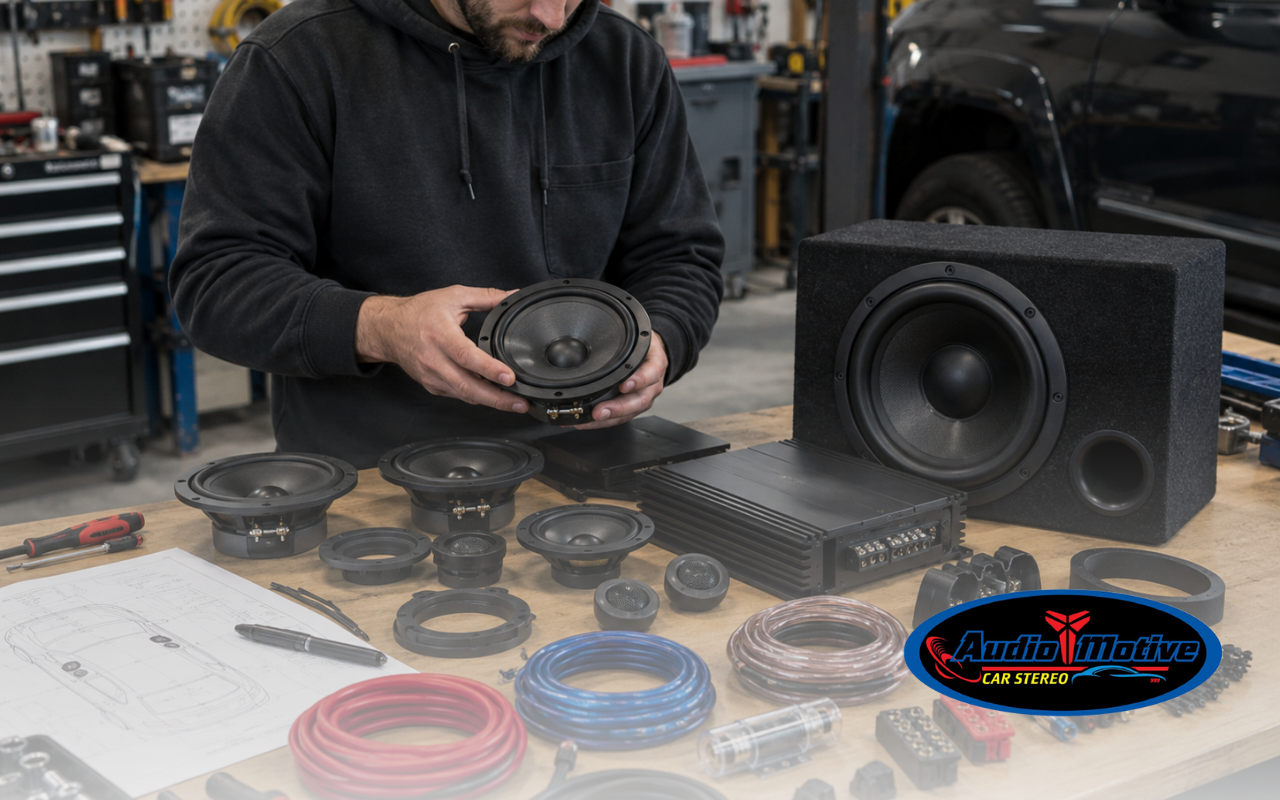
Car audio system planning helps create clearer sound, stronger bass, and better balance without wasting space or money. A good plan also reduces wiring problems, electrical strain, and mismatched parts that can affect daily use.
At Audiomotive, we plan systems around each vehicle, listening style, available space, and upgrade goals. Whether you want a simple speaker change or a multi-amplifier setup, every part should work together from the start.
Start With Clear Goals Before Choosing Audio Components
Before buying parts, decide what you want to hear and how you use your vehicle. Some drivers want deeper bass, while others prefer clear vocals, balanced sound, or more volume with less distortion.
- Your usual music and listening habits
- Desired bass level and overall volume
- Available cabin, trunk, or cargo space
- Plans for future system expansion
These choices guide your speakers, subwoofer, amplifier, head unit, and signal control. They also make car audio system planning easier when your project grows later.
Match Amplifier Power With Speakers and System Needs
For 2026 amplifier recommendations by budget tier, focus first on clean RMS power, channel count, efficiency, and correct impedance. Entry-level builds may use one compact amp, while advanced systems may separate speaker and subwoofer power.
- Mono amplifiers work well for subwoofers
- Four-channel amplifiers can run front and rear speakers
- Class D designs save space and use power efficiently
- Multi-amp layouts give more control in larger systems
Before installation, check fuse needs, cooling space, signal inputs, and speaker load. Our amplifier installation guide explains important setup basics.
Choose Speakers and Subwoofers for Balanced Daily Listening
Speakers shape clarity, detail, and front sound staging. Component sets allow separate woofer and tweeter placement, while coaxial speakers can simplify installation. Size, sensitivity, RMS handling, and mounting depth should fit the vehicle.
Subwoofers add low-frequency impact, but enclosure design matters as much as cone size. Sealed boxes usually sound tighter, while ported boxes can create stronger output. In car audio system planning, bass should support the music instead of covering vocals.
Plan Wiring Gauge and Big Three Electrical Upgrades
Updated wiring gauge standards still depend on cable length, amplifier current demand, conductor quality, and safe fuse protection. Larger systems often need thicker power and ground cable than basic speaker upgrades.
- Keep the main fuse close to the battery
- Use a short, secure ground on clean metal
- Protect cables from heat, sharp edges, and moving parts
- Keep signal cables away from common noise sources
A Big 3 upgrade guide for 2026 vehicles should always account for modern charging controls and factory electronics. For high-demand builds, we inspect the vehicle first instead of assuming every car needs the same upgrade.
Use Signal Processing and Tuning for Cleaner Sound
Equalizers, crossovers, and digital signal processors can improve balance after the hardware is installed. A DSP can control channel levels, crossover points, equalization, phase, and time alignment when the system needs more detailed adjustment.
At Audiomotive, we also check gain settings because amplifier gain is not a volume control. Proper tuning supports car audio system planning by helping each speaker play the right range at a safe level.
Control Cabin Noise and Protect Installation Quality
Road noise, loose panels, and vibration can hide detail even when the audio equipment is good. Sound-deadening material in doors, floors, and cargo areas can reduce rattles and help speakers sound more consistent.
Installation quality also affects long-term reliability. Secure mounting, clean cable paths, correct grounds, and safe fuse placement matter as much as brand choice. You can review examples in our car audio project gallery.
Frequently Asked Questions
How many amplifiers can one vehicle safely support?
There is no single number. The limit depends on total current demand, charging capacity, battery condition, wiring, fuse protection, cooling, and available installation space.
Can I combine mono and four-channel amplifiers?
Yes. A mono amp can power the subwoofer while a four-channel amp powers the main speakers. Both need correct wiring, grounding, signal routing, and fuse protection.
Should I upgrade my car audio system gradually?
Yes. Staged upgrades can work well when the final layout is planned early. This approach helps each new part stay compatible with later additions and supports better car audio system planning.
Do modern vehicles always need Big Three upgrades?
No. Some high-demand systems may benefit, but modern charging systems vary. Testing voltage and current needs first can prevent unnecessary electrical changes.
Does current component pricing affect system planning?
Yes. Current component pricing can change by brand, stock, features, and supply. We recommend setting priorities first so the budget supports the parts that matter most.
Build a Flexible System Ready for Future Upgrades
Good car audio system planning leaves room for future speakers, subwoofers, amplifiers, or signal processing. Choosing flexible wiring routes and expandable connections can reduce repeated labor when the system changes later.
With Audiomotive, you get a plan built around your vehicle and listening goals. Our car audio installation service supports clean setup, careful tuning, and long-term flexibility. For a custom path, reach our team.